BRAND PORTFOLIO
A brand-architecture case study of PRAN–RFL Group — mapping its full portfolio across FMCG and non-FMCG categories to analyze brand strategy, brand naming, and growth through brand extension.
Project Overview
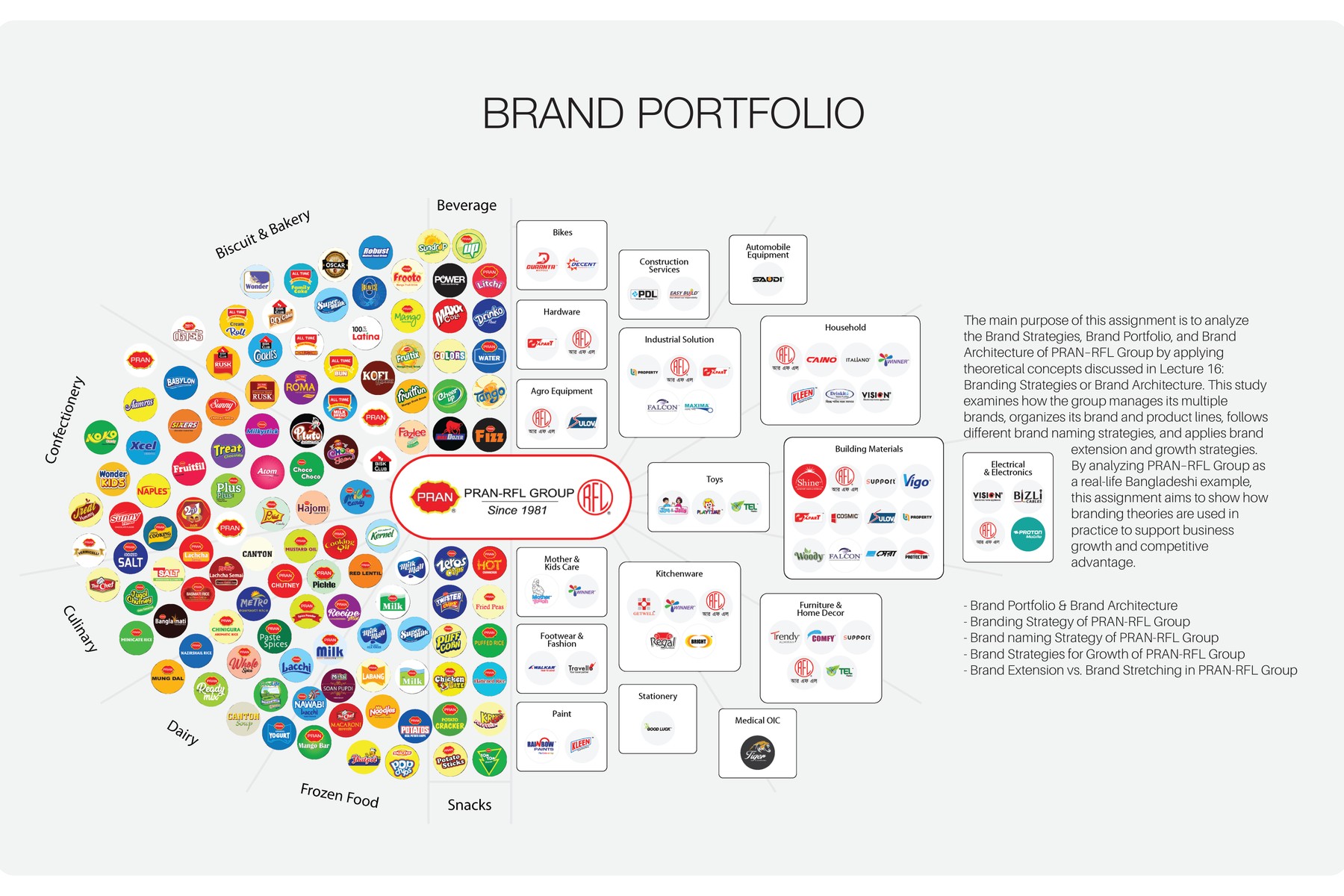
The main purpose of this assignment is to analyze the brand strategies, brand portfolio, and brand architecture of PRAN–RFL Group by applying theoretical concepts discussed in Lecture 16: Branding Strategies and Brand Architecture. This study examines how the group manages its multiple brands, organizes its brand and product lines, follows different brand-naming strategies, and applies brand extension and growth strategies.
By analyzing PRAN–RFL Group as a real-life Bangladeshi example, the assignment aims to show how branding theories are used in practice to support business growth and competitive advantage.
- Brand Portfolio & Brand Architecture
- Branding Strategy of PRAN-RFL Group
- Brand Naming Strategy of PRAN-RFL Group
- Brand Strategies for Growth of PRAN-RFL Group
- Brand Extension vs. Brand Stretching in PRAN-RFL Group
Mapping the Brand Universe
At the center of the map sits the corporate masterbrand: PRAN paired with RFL/AFL under the shared “PRAN–RFL Group · Since 1981” mark. Every category radiates outward from this single hub, visually asserting a branded-house structure at the corporate level even where individual product lines carry very different names.
This dual anchoring — one mark for food & beverage (PRAN), one for durables & industrial goods (RFL/AFL) — reflects a portfolio built from two historically distinct businesses that have since been unified under one group identity.
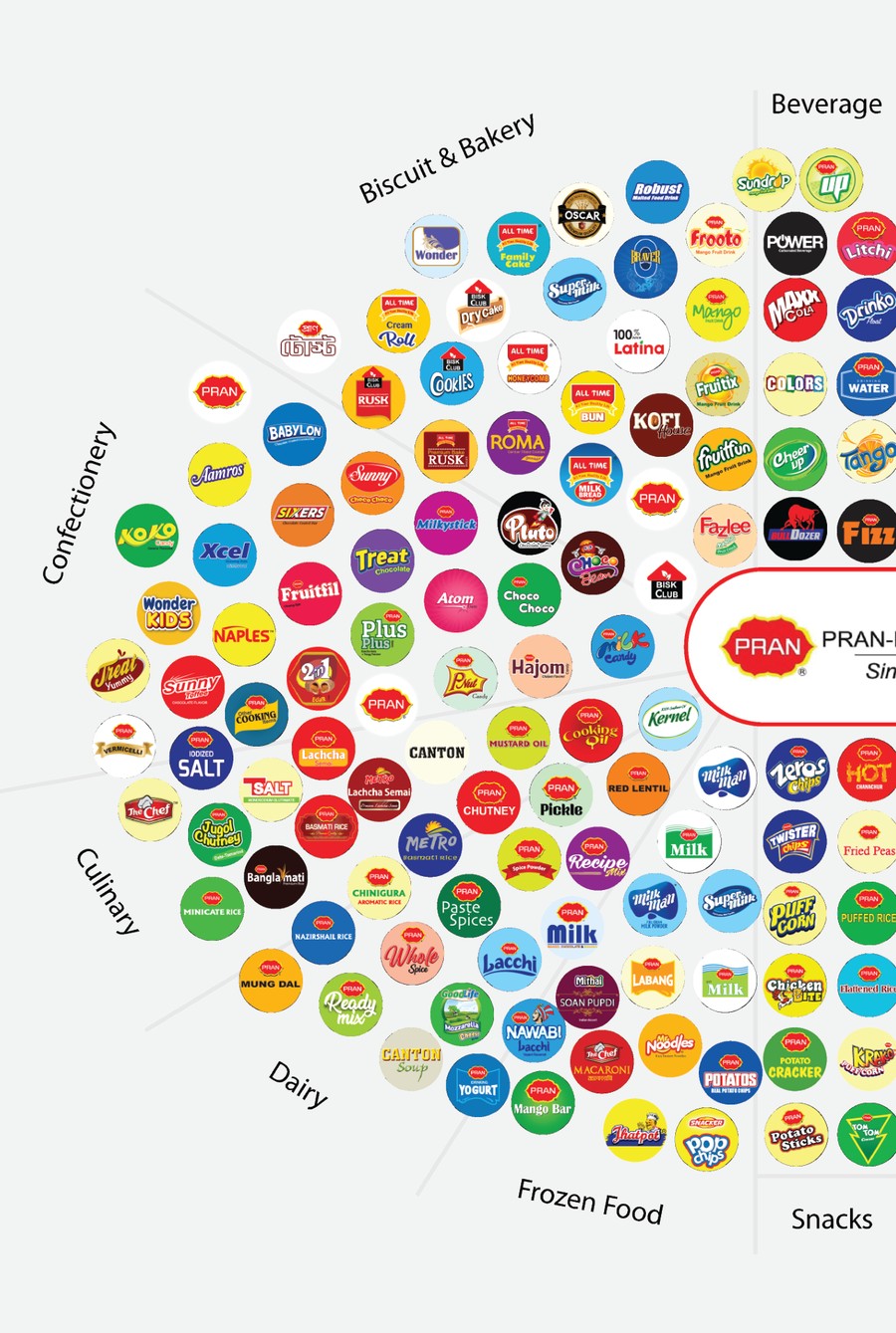
Within this ring, PRAN mixes two naming approaches at once. Many products carry the PRAN name directly as an endorser — PRAN Chutney, PRAN Cooking Oil, PRAN Mustard Oil — borrowing the parent’s trust and food-safety reputation. Others stand almost entirely on their own — Sixers, Sunny, Bisk Club, Frooto, Milk Maid, Koko — functioning as independent sub-brands with their own visual identity and target audience.
This hybrid pattern lets PRAN protect its masterbrand equity in staple categories while giving newer or more competitive product lines room to build a distinct personality.
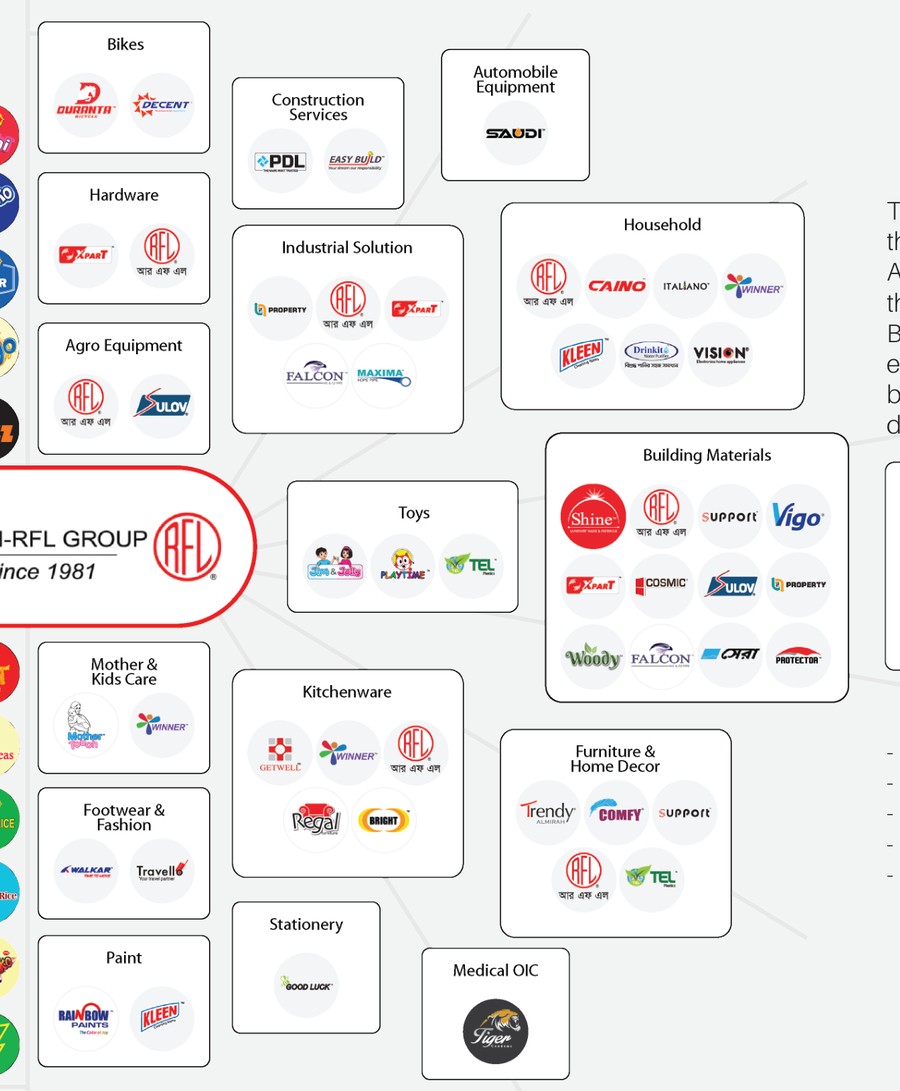
Here the group’s growth strategy shifts from line extension to brand stretching: the same house-of-brands logic (RFL, AFL, Xpart, Falcon, Vision, Kleen, Winner, Ulov, Property, Support, Tel) is reused across categories that share almost no functional overlap — from bicycles to paint to medical apparel.
Grouping each category into its own bordered box, rather than letting it blend into the radial field, visually signals that these are more loosely related “endorsed” sub-brands rather than tightly unified product lines — a deliberate architecture choice for a highly diversified conglomerate.
“PRAN Mango Juice,” “RFL Chair” — the parent name drives instant recognition and trust, at the cost of tying every product’s reputation to the masterbrand.
PRAN spans juice, snacks, spices, dairy and oil; RFL spans plastics, furniture, pipes and household goods — one family name, faster launches, consistent image.
Vision (electronics), Regal (furniture), Duranta (bicycles), Walkar (footwear) — built as their own identities where a category needs a different image than PRAN or RFL can offer.
Line extension adds varieties within a category under one name — PRAN Juice in mango, litchi, orange and guava; Bisk Club in digestive, cream and cracker biscuits.
Category extension moves a trusted name into a new category — PRAN from juice into spices and cooking oil; RFL from plastics into furniture and building materials.
Flanker brands like All Time (bakery) beside PRAN, or Tel Plastics (premium) beside RFL, target different price tiers without touching the core brand.
Extension stays close to what customers already trust (PRAN into snacks, RFL into pipes); when a category is too distant, the group prefers a clean new brand — Vision instead of “RFL Electronics,” Regal instead of “PRAN Furniture” — to avoid stretching risk.
Read the Full Analysis
The complete written assignment — “An Analysis of Brand Strategies, Brand Portfolio, and Brand Architecture of PRAN–RFL Group” — submitted for Promotion & Brand Management (GRD 6101), Department of Graphic Design & Multimedia, Shanto-Mariam University of Creative Technology.

(0)