MA Coursework · Experimental Design
Rickshaw Painting & Beyond
Tracing a Vernacular Visual Language
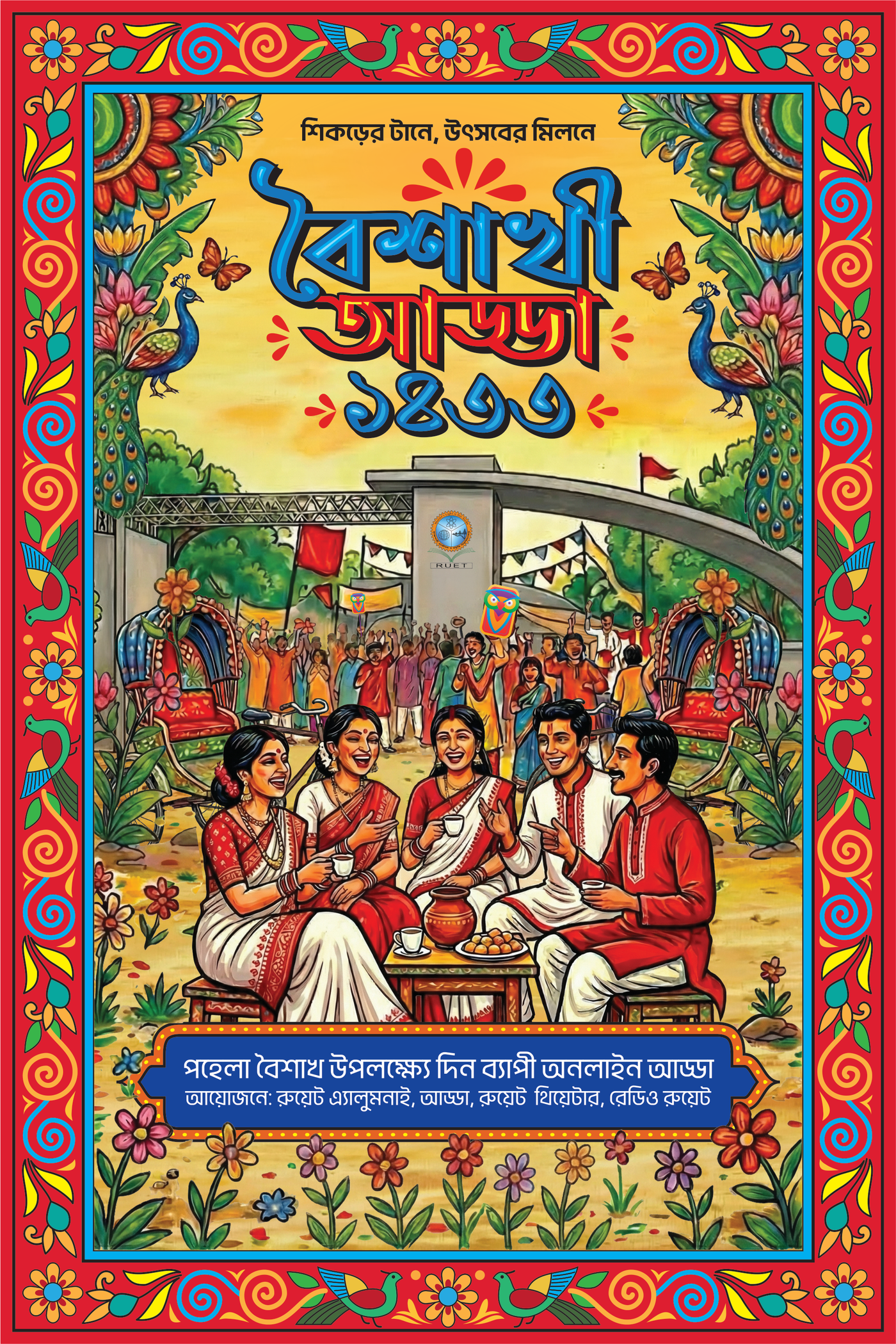
A poster designed for RUET’s day-long Pohela Boishakh adda — commissioned by the university’s alumni association together with its cultural circle, theatre group and campus radio — built entirely in the visual grammar of Dhaka’s rickshaw painting: saturated enamel colour, flower-and-bird ornament, and hand-built Bangla lettering. A film extending the same visual language is currently in development.
Course
Experimental Design
Instructor
Mohammed Shakhawat Hossain Sarker
Discipline
Graphic Design, Poster
Occasion
Pohela Boishakh 1431
Organized By
RUET Alumni, Adda, Theatre & Radio
Project Overview
Rather than illustrate the festival literally, the brief was to borrow directly from Rickshaw Chitro — the itinerant, self-taught painting tradition found on Dhaka’s cycle-rickshaws — as a ready-made vernacular visual system: its palette, its ornament, its way of building a picture from flat, saturated shapes rather than tonal rendering. The poster explores a hybrid visual language that merges that cultural nostalgia with digital connectivity, reflecting both the spirit of Pohela Boishakh and the technological identity of the RUET community.
The final artwork sets a Boishakh street-gathering scene — friends sharing tea under RUET’s iconic campus gateway — inside a hand-painted floral-and-peacock border, with the event’s own hand-built Bangla title, “বৈশাখী আড়্ডা ১৪৩১” (Boishakhi Adda, 1431), treated as the poster’s centerpiece rather than an afterthought.
Design Thinking
Process
Color
Bright & high-contrast enamel paint — the palette rickshaw painters have always worked in, chosen for maximum legibility across a crowded noticeboard and a small phone screen alike.
Motif
Flowers, birds and creeper flourishes — the natural, decorative vocabulary that borders almost every hand-painted rickshaw panel in Dhaka — repeated as a continuous ornamental band around the poster’s edge.

Mnemonic — Logotype Development
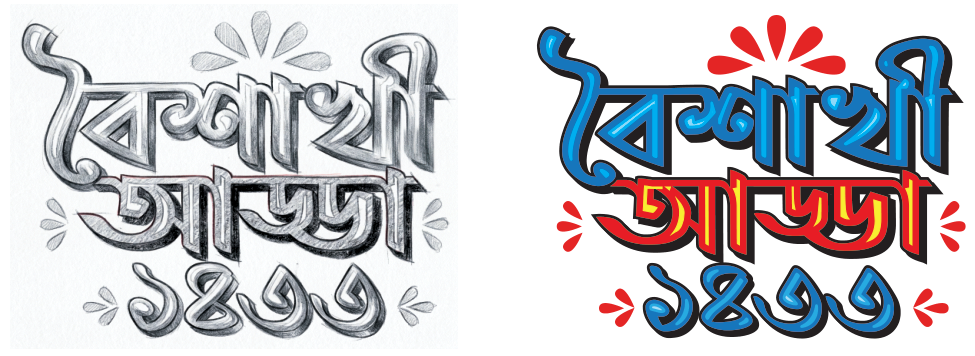
The title lockup, “বৈশাখী আড়্ডা ১৪৩১,” was hand-built as its own piece of rickshaw-style lettering — flourish patterns symbolizing Bangla calligraphy — pencil construction first, establishing the shadow logic rickshaw signwriters use to make flat paint read as dimensional metal, then finished in the poster’s red–blue–yellow palette.
Elements
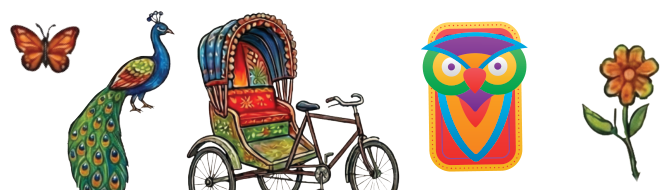
Butterfly, peacock, rickshaw, owl, flower — a small stock of recurring rickshaw-art iconography, built as reusable elements that could carry the same visual language into flags, banners and the festival’s other collateral.
People — AI-Assisted Illustration
The figures in the foreground weren’t drawn freehand — they started as ordinary reference photographs of the people the poster was for, then were run through AI image generation to repaint them in the same rickshaw-painting language as the rest of the piece: flat enamel colour, heavy outline, the slightly exaggerated proportions rickshaw artists use for faces and hands. It let real, recognisable people sit naturally inside a fully hand-painted-looking scene, without hand-illustrating every figure from scratch.
Course Instructor

Mohammed Shakhawat Hossain Sarker
Part-Time Faculty
Email: shakhawat.sobuj@gmail.com
Cell: +880 1873013641
(0)